
The online Oxford English Dictionary has several definitions for "lacuna," a word derived from the Latin, lacūna, meaning a hole or pit. A lacuna can refer to a missing portion of a text, manuscript or inscription; a physical gap or cavity (esp. in physical science), a lexical gap (in linguistics), or perhaps even those long periods of silence musician's write into their compositions.
This term is also the title to Barbara Kingsolver's novel. I've been interested in reading this book since watching the film Frida and slightly obsessing over Frida Kahlo's life and art. The novel is set up as a series of journal entries, news paper clippings and letters from the life of Harrison Shepherd, a man pulled between two countries. In Mexico, he becomes entangled in the lives of Frida Kahlo, Diego Rivera and Leon Trotsky. In the U.S., Shepherd writes historical romance novels about ancient civilizations in Mexico and is accused of communist behavior during anti-communist America.
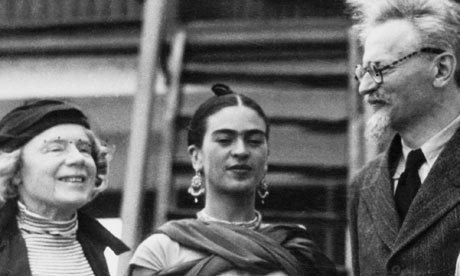
The lacuna motif was my favorite part about reading this book. The story itself is missing a piece of Shepherd's life because he burns one his journals to hide a supposed scandal. This pushes the reader farther away from him, like he's saying, "I don't want you to know that much about me." Even though we're reading his inner thoughts, Shepherd remains a mysterious figure. The lost journal is what we don't know about Shepherd--possibly the most important thing about him.
"The notebook that burned, then. People who make a study of old documents have a name for this very kind of thing, a missing piece. A lacuna, it's called. The hole in the story..."
There is also a cave, at the beginning and the end of the story. This physical lacuna plays a significant role in Shepherd's life.
"... lacuna. He said it means a different things from lagoon. Not a cave exactly but an opening, like a mouth, that swallows things."
The novel also wrestles with ideas about how we know people. Or, more accurately, how we don't know people. Throughout the rest of his life, Shepherd holds close to Frida's statement about what we don't know about people. When false statements are made about him in the press, his stenographer wants him to deny the claims. Shepherd refuses, insisting on a "no comment." Their following conversation is my favorite passage:
" 'When they have nothing, they fill in. If you don't stop them, they fill in more. It's like you've agreed to it. To their way of thinking, saying nothing is the same as agreeing.'
'Are you saying it's my responsibility to stop another man from lying?'
'Well. No. It's his to stop himself.'
'Dios habla por elque calla'
'Meaning what, Mr. Shepherd?'
'God speaks for the man who keeps quiet.'
'If you say so.'
' "No comment" means "no comment." It does not mean, "I hate to admit this, but yes, he has a punctured eardrum." '
'Well, people think that. And taking the Fifth means you're guilty.'
'Whatever they may think, it does not. A blank space on a form, the missing page, a void, a hole in our knowledge of someone--it's still some real. It exists. You don't get to fill it in with whatever you want. I'm staking myself on principle, Mrs. Brown. This country promises us the presumption of innocence.'
'Presumptions we have got, Mr. Shepherd. Coming out our ears.'
'What would you have me say? Mr. Shepherd does not have a punctured eardrum, he does not have a friend from college days, he does look at pretty girls without whistling--oh, that's a trap. Where does it stop?'
She had no answer.
'If that atl-atl was meant as a symbol for the atom bomb, can't we let the reader have a chance to decide?'
'Well, I know what you're saying. The reporters would have you put in the grinder and feed you to Baby with a spoon.'
'I don't think the reporters really want to know the first thing about me. They fancy themselves artists. They'd rather draw freehand.'
'They do have questions.'
'I know. The one fellow wanted to ask me about Truman and the Soviet containment policy, remember? Colliers, I think.'
'New York Times. Colliers said they wouldn't even run a review unless you spoke to them.'
'And did they?'
'A little one. It wasn't very good.'
'If I talked, I would only end up giving them more blanks to fill in. "How do you feel about Truman's new anti-Soviet position, Mr. Shepherd?" No comment. "That Bette Davis is quite a looker, isn't she, Mr. Shepherd?" No comment.'
'So, the punctured eardrum. No comment.'
'Correct.'
'Next they'll be reporting you died'
'Imagine the peace and quiet.' "
I love that he doesn't rise to defend himself. He allows his lacunae to exist and doesn't insist on being known. I found this passage quite poignant--struck a chord with me. I think I've spent so much of life trying to be known by others. Trying to defend myself when others think I'm wrong. But I don't have to. Sometimes a silent "no comment" is the more appropriate choice. I'd like to keep a few more blank lines.
After reading this book, I've been noticing and thinking about the lacunae around me (but less in the literal sense). I thought I would share one of my library lacunae. In a series of volumes, it's a little awkward having one or two missing--they leave a gap. The books tend to fall over, or look uneasily at rest. When I put a volume back in place, there's a sense of relief. Like I've put something right again.
library's lacuna
shelve books like you fill
the cracks in your skin,
the holes in your heart,
the melancholy gap on a shelf
where one volume's missing.

No comments:
Post a Comment